Home » Recommended Resources & News » The Multiplier Effect of Local Independent Business Ownership

The Multiplier Effect of Local Independent Business Ownership

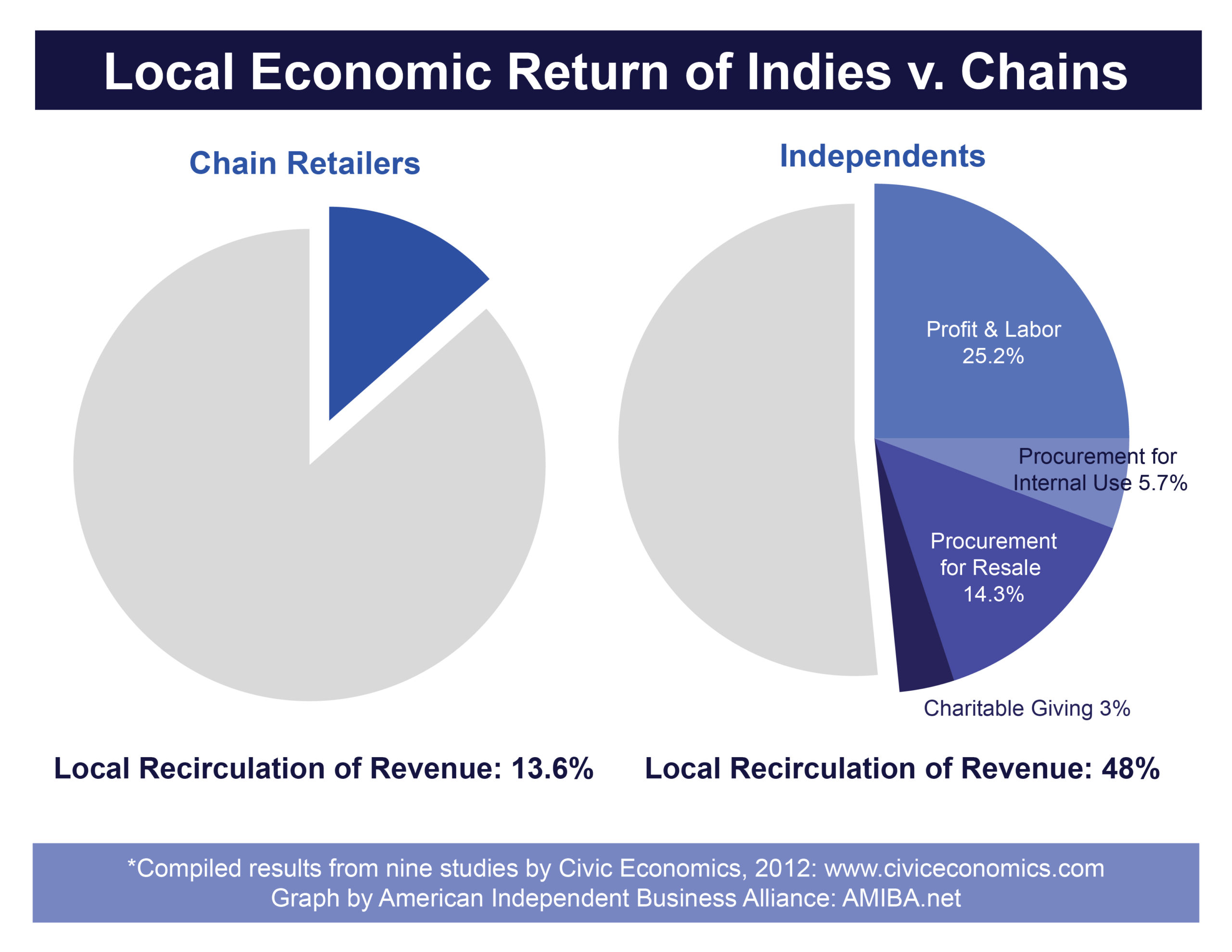
Explaining the local economic multiplier effect or “local premium” is an essential component of effective "buy local" public education campaigns. The multiplier effect is the boost to your local economy that results from locally-owned independent businesses, owners, and employees spending business revenue within the region. Typically, local independent businesses recirculate a much greater percentage of sales locally compared to absentee-owned businesses (or most locally-owned franchises*).

 Total economic impact is determined by measuring three components -- the direct, indirect, and induced impacts.

  • Direct impact is spending done by a business in the local economy to operate the business, including inventory, utilities, equipment and pay to employees.
  • Indirect impact refers to the conventional multiplier that happens as dollars the local business spends at other area businesses re-circulate.
  • Induced impact refers to the additional consumer spending that happens as employees, business owners and others spend their income in the local economy.

Studies

Civic Economics' study for the City of Austin, Texas in 2002 found $100 spent at the local independent retailers in the study generated $45 of secondary local spending compared to $13 in secondary spending projected per $100 spent at a Borders Books and Music store. These studies measured the direct and indirect impacts to determine the base level local economic activity of a purchase made at a chain and a local independent business.

The Institute for Local Self-Reliance conducted perhaps the simplest study of the local multiplier effect in several small Maine communities in 2003. It explored how much of a dollar spent at a local independent store is re-spent in the local area in the form of payroll, goods/services purchased from area businesses, profits spent locally by owners, and donations to area charities. The study found each $100 spent at local independents generated $45 of secondary local spending, compared to $14 for a big-box chain.

Civic Economics studies in San Francisco and Chicago expanded the exploration of the indirect impacts by including more business types (see discussion below) and added induced impacts, so the results are not directly comparable to their Austin study or ILSR's Maine study.

Key Points
Civic Economics' Andersonville neighborhood study yielded a total impact of $68 per $100 of spending at ten local independents, compared to $43 projected for their chain competitors. Bear in mind this is a study of just ten businesses in one neighborhood of one large city (significant because businesses in smaller cities and towns may have less ability to locally source some necessary inputs). Also, the projection of indirect and induced impacts does not mean that $.68 of a dollar spent at a local independent "stays" in the local economy, but that $.68 of additional local economic activity ultimately is generated. Citing the higher numbers without explaining they include impacts by entities other than the original business and refer to specific communities is misleading.

To gain respect and be seen as an authoritative voice within your community or constituency, you should guard your credibility zealously. Check your materials and ensure they convey verifiable, accurately worded information! We suggest sending people to Civic Economics.com and NewRules.org for summaries and links of most relevant economic studies in this realm. We urge you not to rely on any secondary sources or attributions. The New York Times published a false claim that 80% of money spent with local independents was re-spent locally. Subsequently, at least two other publications then attributed the claim to AMIBA! Verify claims by referencing (and citing) the original study or contact us for more general questions. We also are happy to provide graphics on request.

Details on Study Variants

Business Type

 The size of the local premium varies depending on the type of business. This is where the San Francisco and Grand Rapids studies get interesting, because they work out the local multiplier for different business categories. Restaurants and service providers generate a large multiplier because they are labor-intensive and, therefore, much of that $100 spent goes to local payroll. Pharmacies, for example, generate a lower multiplier because so much of each sale goes to drug manufacturers. Retailers, unless they source an exceptionally high percentage of their goods locally, also create a more modest multiplier.

This is not to say restaurants are better for economic development than pharmacies. Pharmacies have sizable revenue and at least one paid professional, so it's great for the local economy. It's helpful to be aware of these differences because reporters sometimes ask why the local multiplier is a little different in each study. In large part, it's because they are looking at a slightly different mix of businesses.

Quantifying Shifts in Spending
As for the overall impact on your local economy of shifting 10% of purchasing from non-local or asbestee-owned to locally owned businesses, you would need to know what the local multiplier is for each category of spending and what percentage of people's spending is in each category. (i.e., 20% goes to groceries and the grocery multiplier is 0.15; 5% goes to books and the local multiplier is 0.32; etc.)

Presumably, this is how Civic Economics arrived at the Grand Rapids figures for the impact of shifting 10% of all retail sales. The figure in that study works out to an average local multiplier of 0.16 across all retail categories.

Thanks to Stacy Mitchell of ILSR for providing the framework for this explanation. ILSR summarizes and links most relevant economic impact studies here.

* = Since we’re debunking misinformation, we’ll also note that, despite the claims by countless franchisors (the companies that sell to a person wishing to operate a franchise--the franchisee), franchised businesses overall are no more likely to succeed than independent businesses and typically deliver a worse return on investment, as this article explains).